

Black Culture

For decades, the concept of "Black culture" has been presented as a cohesive and celebrated inheritance—a natural outgrowth of shared history and experience. However, this truth exposes the lies: the identity widely marketed and consumed as modern "Black culture" is not the authentic continuation of the true heritage of the people (Yashar’al), but a carefully manufactured construct. This manufacturing process, forged by the damning forces of slavery, colonization, and media programming, includes the deliberate creation of new, often misleading, identifying labels
—even concepts like "Black Hebrew Israelites"—which ultimately serve to mask the people's core identity and further perpetuate the lies of the system. By pulling back these layers, from imposed slavery labels to commercialized symbols, this fabricated culture, designed to control, distract, and commercialize the people, clearly shows how it was designed to disconnect the chosen ones from their true ancestral roots.
The Prophetic Blueprint of Cultural Erasure

The first proof lies in the forced identity created during slavery. Enslaved Ibriym (Hebrews)—those who cross over—were stripped of their tribal names and given slave labels that evolved into terms such as “Negro,” “Colored,” and eventually “African American.” These labels did not reflect heritage, but instead imposed categories built by colonizers. This renaming and reframing were the first steps in manufacturing a culture that could be shaped and steered according to the interests of foreign powers. Furthermore, Slave Codes throughout the Americas strictly enforced the prohibition of reading, writing, and unauthorized assembly, ensuring that the generational transmission of history, language, and covenant memory was legally impossible. Scripture had already warned of this stripping away as part of the curses: “And you shall become an astonishment, a proverb, and a byword, among all nations where 𐤉𐤄𐤅𐤄 (YaHU’aH) shall lead you” (Deuteronomy 28:37). The loss of name, identity, and true memory was no accident—it was prophecy.
This prophetic fulfillment is nowhere more evident than in the deliberate engineering of a false religious identity. The very existence of writings like “How to Make a Negro Christian” shows how colonizers deliberately engineered a false identity to erase the covenant memory of the Hebrews. This book was not simply a religious training tool—it was a weapon of prophecy. 𐤉𐤄𐤅𐤄 (YaHU’aH) had warned, “I said, I would scatter them into corners, I would make the remembrance of them to cease from among men” (Deuteronomy 32:26). By stripping the Hebrews of their tongue, renaming them “Negro,” and forcing them into the twisted lies of Christianity that worshiped in the image of their oppressors, the nations fulfilled what the Torah already declared.

This system was never about the true Way. It was about molding captives into a submissive people who could not recall their covenant heritage. It created a class of "believers" who shouted “praises” to the very names and images that enslaved them, while their true identity was locked away.
The colonizer’s religion was forced upon them as a mask, so that the descendants of Abram would forget their own language, their own culture, and their own AL’uah (Mighty One). Yet even this was part of the covenant design. The four hundred years of affliction prophesied to Abram (Barashiyth (Genesis) 15:13–14) had to run its course. From 1619 to 2019, a false “Negro Christian” identity served as the cage to keep the Hebrews hidden. But now, as the time of awakening arrives, the chains of that false book are broken. The so-called Negro is revealed to be the chosen seed, rising again in remembrance of 𐤉𐤄𐤅𐤄 (YaHU’aH).
The Curses of Slavery and Covenant Severance
Before the shipping into slavery, 𐤉𐤄𐤅𐤄 (YaHU’aH) had already declared another curse—that the once massive nation would be reduced down to a few in number (Deuteronomy 28:62). This shrinking of the people was a clear warning before the final scattering. The transatlantic slave trade itself was the foundation of this stripping. Men, women, and children were violently uprooted, shackled, and shipped across oceans, deliberately separated from kin and tribe so that all memory of their true identity would be erased. Unlike other peoples who carried language and history across borders, the Ibriym (Hebrews) were cut off by force. This was the ultimate curse fulfilled: “And 𐤉𐤄𐤅𐤄 (YaHU’aH) shall scatter you among all people, from one end of the earth even unto the other; and there you shall serve other mighty ones... even wood and stone” (Deuteronomy 28:64). The curse of scattering was designed to leave them without their tongue, their customs, and their remembrance—THE DISAPORA.
The crushing nature of this curse is captured in the prophecy of Deuteronomy 28:68: “And you shall be sold unto your enemies for bondmen and bondwomen, and no man shall buy you.” This did not mean the Hebrews would not be purchased in the slave markets—history proves they were—the truth is deeper: it meant there would be no kinsman-redeemer to ransom them from captivity. In the Torah, redemption was a commanded custom.
Leviticus 25:47–49 teaches that if a Hebrew became poor and sold himself into bondage, “after he is sold he may be redeemed again; one of his brethren may redeem him.” This is the covenant right of the go’al—the near kinsman—whose duty was to buy back his brother or his brother’s inheritance so that the family line and heritage would not perish. We see this custom beautifully displayed in Bo’az, who redeemed Ruth and Naomi’s inheritance (Ruth 4:1–10). As the kinsman-redeemer, Bo’az stepped forward to raise up the name of the dead upon his inheritance, preserving the covenant lineage. This was the commanded heritage of Yashar’al: no family was to be cut off, for 𐤉𐤄𐤅𐤄 (YaHU’aH) set redemption into the very structure of their society. But under the curses, this covenant safety net was stripped away. When the Hebrews were taken on ships and scattered, there was no Bo’az, no brother, no redeemer permitted to ransom them. The very thing that identified them as a covenant people—the right of family redemption—was removed. They were sold, but “no man shall buy you” meant no relative would be allowed to act as the redeemer, no kin would deliver them out of slavery. This is the crushing weight of Deuteronomy 28:68: not just enslavement, but the severing of the covenant protection that ensured their heritage. Their inheritance was hidden, their names erased, their remembrance made to cease among men (Deuteronomy 32:26). Only 𐤉𐤄𐤅𐤄 (YaHU’aH) Himself could step into the role of Redeemer.

It is also important to make clear that not all so‑called Black people are of the tribes of Yashar’al. The curses did not fall on every dark‑skinned people. They came upon the covenant people who were carried away in ships, as prophesied in Deuteronomy 28:68: “And 𐤉𐤄𐤅𐤄 (YaHU’aH) shall bring you into Mitsrayim again with ships... and there you shall be sold to your enemies for male and female slaves, and no man shall buy you.” This unique sign—captivity by ships—marks who the true children of Yashar’al are. Many other people of darker skin across the earth did not experience this same fulfillment, proving that skin color alone does not define covenant identity.
When the tribes arrived in the lands of so‑called America, history shows that there were already dark‑skinned people dwelling there. The so‑called Native Americans, who were labeled “Indians” by Europeans, were already present. The crucial point, however, is that history confirms these indigenous people did not arrive by way of the slave ships—thus differentiating their covenant status from the people fulfilling the curses of Deuteronomy 28:68.

Structural Control and Economic Dispossession

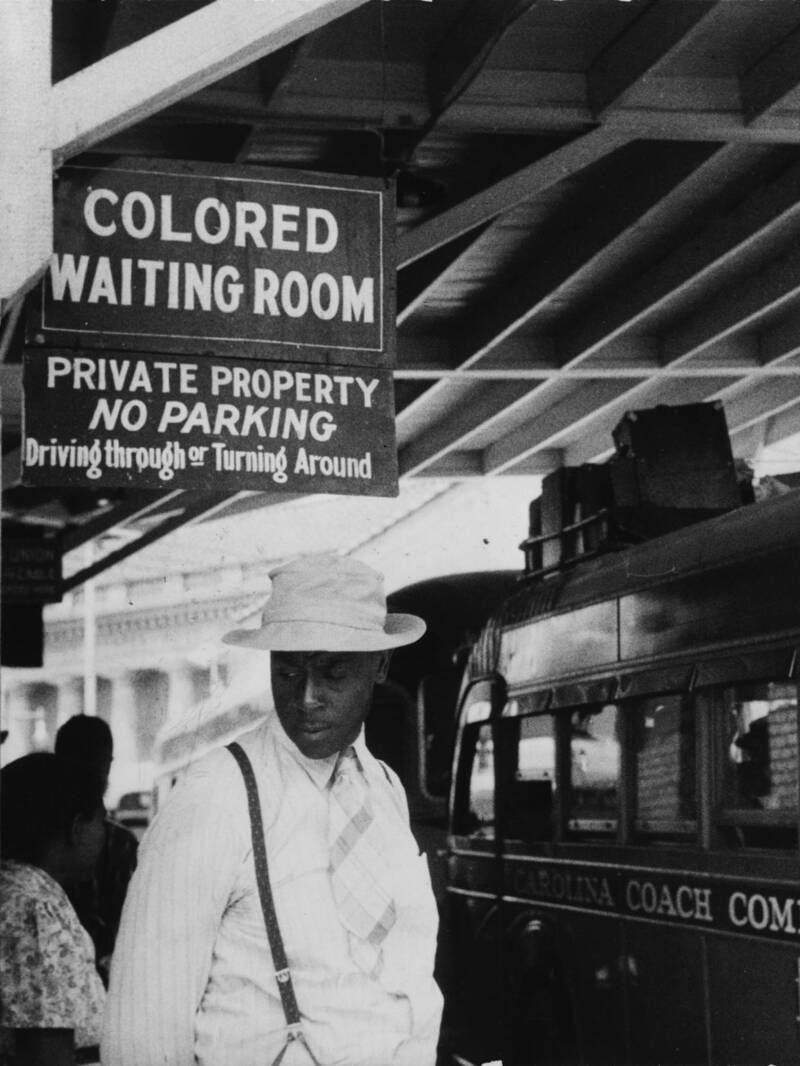
As slavery gave way to segregation, the Jim Crow era introduced stereotypes that would later form much of the imagery tied to “Black” identity. Mocking stage shows, cartoon-like images, and overdone performances of “Blackness” reinforced false ideas of what it meant to be Black. Hollywood later carried this same script into low‑budget Black action movies, where characters were exaggerated criminals, hustlers, and clowns. Rather than celebrating true heritage, these depictions trapped people in cycles of entertainment-driven identity. These humiliations were not random—they were the bitter fruit of the curses: “You shall be only oppressed and crushed always” (Deuteronomy 28:33).
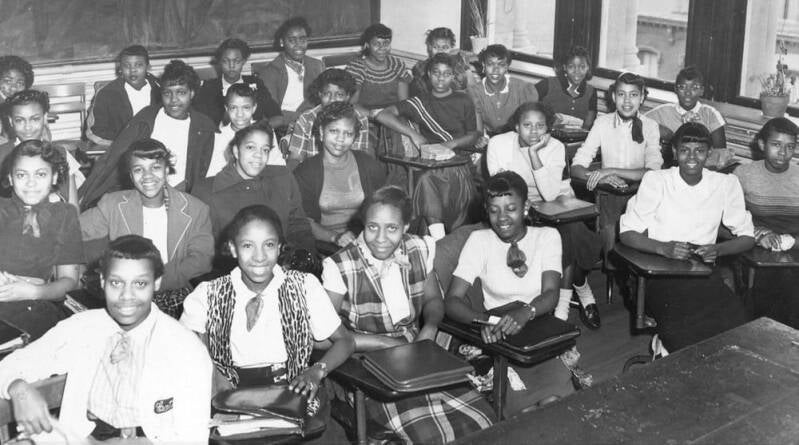
Education systems played a major role in this process. Colonial schools, missionary teaching, and later state-run curriculums ensured that the children of Yashar’al never learned their true history or tongue. Instead, they were taught to honor the achievements of their oppressors and to despise their own heritage. YarmiYAHU (Jeremiah) warned of this stripping away: “And you, even yourself, shall discontinue from your heritage that I gave you” (Jeremiah 17:4).
No other people on earth have been deliberately forbidden from speaking their native language, remembering their ancestry, and practicing their covenant customs in the same way. This is why the so‑called Black people stand as the only nation without remembrance of their true roots.

A critical, often overlooked, pillar of the manufactured culture is the intentional destruction of the covenant family structure. Policies ranging from the forced separation of families during slavery to later, post-emancipation government systems incentivized the absence of the patriarchal head of the household. This systemic dismantling prevented the creation of stable, multi-generational wealth and, more importantly, broke the divine order required for the true transmission of covenant history, law, and culture. The result is a people structurally incapable of unified self-determination because the foundational unit—the family—was legally and financially targeted for destabilization.

The most insidious weapon utilized for this purpose in the post-Jim Crow era was the welfare system, specifically programs like Aid to Families with Dependent Children (AFDC). These policies were explicitly structured to deny aid to households where an able-bodied man (the father) resided, creating a powerful economic incentive for the head of the household to exit the home. This government-mandated structure ensured the continued disintegration of the male role within the family, tying dependency directly to the system of control. This serves as a modern fulfillment of the curse of being perpetually under the enemy’s control and serving them in “want of all things” (Deuteronomy 28:48), by making the very provision of need conditional upon the destruction of the divine family order.
The manufactured identity also relies heavily on economic colonization and the creation of debt cycles. While the concept of "Black Wall Street" represented organic, covenant-aligned economic independence, these structures were systematically destroyed. In their place, the people were driven into a cycle of hyper-consumerism, celebrated by the media (sneaker culture, luxury brands, bling) and enforced by discriminatory lending and housing practices, ensuring that wealth was extracted and intergenerational debt replaced inheritance. This system of economic control keeps the community perpetually focused on chasing external acceptance (materialism) rather than building independent community strength.
Manufactured Identity and Media Distraction

By the late 20th century, institutions such as BET programming, the invention of Black History Month, and the commercialization of hip-hop reinforced the same themes. BET did not present the authentic story of Yashar’al, but instead recycled stereotypes and marketed entertainment to keep a people occupied. Black History Month reduced a rich and vast history to a narrow set of figures chosen to fit a narrative. Hip-hop, once a raw community voice, was turned into a worldwide business centered on gangsta rap, hyper-materialism, and violence. This commercial evolution deliberately supplanted earlier forms of musical resistance, such as the protest embedded in Blues and the spiritual hope in true retold history, replacing them with content tailored for marketability, distraction, and the normalization of internal conflict. These were not organic cultural developments—they were manipulated and mass-produced for consumption. This too reflects the curse: “The stranger that is within you shall get up above you very high; and you shall come down very low” (Deuteronomy 28:43).

Sports became another cornerstone of manufactured identity. The worship of NBA and NFL stars was elevated as proof of “Black excellence,” but in reality, it reduced achievement to physical performance within arenas controlled by billion-dollar corporations. Sneaker culture, chain and bling promotion, and rapper-driven fashion trends reinforced this cycle, making consumerism the foundation of pride. This was culture created in boardrooms, not passed down through covenant lineage.

Even symbols of resistance were manufactured and redirected. The afro was turned into a political symbol. The Black power fist was absorbed into political branding. Events such as Juneteenth were commercialized, while "holidays" like Kwanzaa were invented outright in 1966 and sold as ancient tradition when they were not. Likewise, the adoption of the Pan-African flag, the dashiki fashion fad, and the boom of Afrocentric bookstores in the 1990s all became short-lived markers of identity—external forms without grounding in authentic truth.

Media and entertainment continued to flood this manufactured culture with distortions. Tyler Perry character types, Madea roles, Martin, and baby mama drama normalized dysfunction. Def Comedy Jam, Soul Train, and MTV Cribs esteemed stereotypes of comedy, dance, and materialism. Black Greek fraternities and step shows claimed heritage but were crafted out of European lodge systems, not covenant traditions. Even political movements like Black Lives Matter became branded, funded, and redirected by external influences.
The so-called Black church in America was not born from the covenant heritage of Yashar’al; it was engineered under slavery as part of the curses. Enslavers knew they could not erase Way in 𐤉𐤄𐤅𐤄 (YaHU’aH) from the Hebrews they had captured, so they created a new system of worship to control them. Manuals like “How to Make a Negro Christian” were not myth—they contained explicit instructions on how to take the Hebrew captives, strip their names and language, and teach them falsehood of Christianity built on the image of their oppressors.
The strategy was to wait for the first generation of enslaved Hebrews to die off, knowing the elders carried the memories of their homeland, their customs, and their covenant. During this time, the enslavers deliberately re-wrote the history the children would hear, forbade the true tongue, punished the mention of their AL’uah’s Name, and flooded their minds with a counterfeit good news. By the time the next generation was grown, the plan was that they would no longer know who they
were, but would think of themselves as “Negro Christians” loyal to the very systems that oppressed them. This was the fulfillment of Deuteronomy 32:26, “I said, I would scatter them into corners, I would make the remembrance of them to cease from among men,” and of the 400-year affliction promised to Abram in Barashiyth (Genesis) 15:13–14.

It explains why the colonizers built churches for the enslaved, selected the preachers, edited the scriptures read to them, and outlaws the texts that revealed their true identity. It was not simply “religion”; it was the final stage of the erasure of covenant memory. Today, as the time of awakening arrives, the blueprint of “How to Make a Negro Christian” is exposed. The book itself shows the lengths to which the oppressors went to ensure the seed of the Hebrews would inherit lies rather than the truth of 𐤉𐤄𐤅𐤄 (YaHU’aH). This is why the “Black church” of America often mirrors the traditions of Rome more than the Torah of 𐤉𐤄𐤅𐤄 (YaHU’aH)—it was designed that way from the beginning.
Furthermore, the modern corporate and governmental push for Diversity, Equity, and Inclusion (DEI) must be exposed as the system’s latest mechanism of management and control, not liberation. DEI institutionalizes identity fragmentation by emphasizing superficial differences (skin color, gender) while simultaneously prohibiting any discussion of true covenant heritage, divine law, or structural autonomy. It grants institutional validation and the promise of acceptance—a form of "table scraps"—to a select few who agree to operate within the established system’s framework, effectively neutralizing independent intellectual leadership and ensuring the manufactured identity remains centered on worldly definitions of "success" and "excellence" rather than divine truth.


Through all of this, the manufactured culture has been upheld by cycles of validation from outside institutions. Grammy and Oscar awards became moments of pride, but they were rooted in recognition from systems never built for covenant truth. NAACP awards and corporate sponsorships reinforced the same dependence. Black Twitter outrage cycles and “woke” branding kept emotions stirred, but rarely grounded anyone in covenant history. Even the slogan of “Black Excellence” turned into consumerism—an endless chase after wealth, image, and acceptance rather than true heritage.
The Manufactured Dream, How Righteous Suffering Was Redirected Into a System-Approved Future

One of the most powerful tools ever used to reshape the direction of an oppressed people was not chains or whips, but hope framed inside the limits of the very system that caused the suffering. The figure most often used to deliver this redirection was Martin Luther King Jr., whose message has been frozen in time, selectively edited, and repackaged as the moral foundation for modern “equality,” “integration,” and ultimately a one-system world ideology disguised as peace and unity.
The popular version of King taught in schools and promoted by media is not the full man, nor the full movement, nor the full agenda of the civil-rights era. His most repeated phrase, “I have a dream,” has been transformed into a worldwide slogan meaning assimilation into the existing power structure, not restoration of identity, land, covenant, or self-governance. The dream that is celebrated is not freedom from domination, but acceptance within it.
This is critical to understand, because systems do not reward voices that threaten their survival. They elevate voices that can stabilize unrest while keeping the same power hierarchy intact. During a time when many were questioning economic control, land theft, labor exploitation, military abuse, and colonial expansion, the message that was promoted and preserved was one that redirected anger away from systemic overthrow and toward social blending.
What followed was not liberation, but integration into economic dependency, political manipulation, military recruitment, prison systems, and cultural pacification through entertainment and consumerism. The chains changed form, but the structure of control remained.

King’s image is now used worldwide as proof that peaceful compliance within corrupt systems is the highest moral path. His words are routinely cited by politicians, international organizations, and corporate institutions to justify unity movements, diversity campaigns, and population-level psychological conditioning that pushes people toward centralized governance framed as humanitarian progress.
This is not accidental. The same language of brotherhood and unity is now used to promote borderless systems, centralized digital economies, behavioral monitoring, and international policy enforcement, all under the banner of peace and safety. The emotional power of civil-rights suffering is exploited to sell the idea that resistance itself is immoral, while obedience to expanding authority is portrayed as righteousness.
Yet true freedom has never come from merging into the systems that enslaved us.
Real restoration requires truth, land, identity, accountability, and covenant loyalty, not symbolic inclusion into institutions built on theft and bloodshed. But that message does not produce stable empires. It produces sovereign people, and sovereign people do not sustain control structures.
So the narrative was softened. The anger was sanitized. The resistance was domesticated. And the dream was repurposed.
Today, the same strategy continues. Movements are allowed to exist only if they can be redirected into voting booths, consumer campaigns, social-media activism, and international humanitarian branding, while the economic and political machinery remains untouched. This is not justice. This is containment.
The tragedy is that many sincerely believe they are honoring the struggle, while unknowingly advancing the same consolidation of power that has always depended on the loss of true identity, family structure, moral authority, and covenant accountability.
The dream that is being sold to the world is not freedom.
It is managed harmony under expanding control.
And history shows that empires do not collapse because of hatred.
They collapse when people finally refuse to believe the narratives that keep them compliant.
The Freemason Connection, Fraternal Networks and Political Gatekeeping
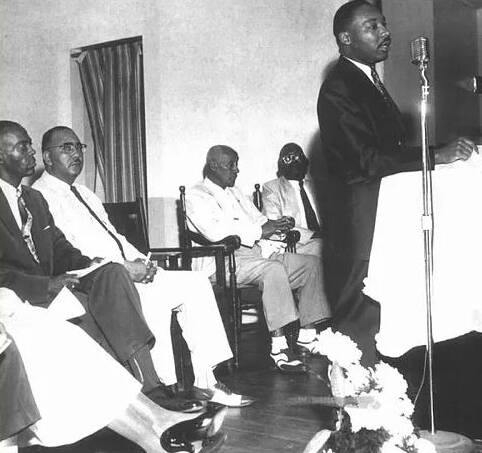
Dr. Martin Luther King, Jr. speaks at the Prince Hall Masonic Lodge in Columbus, Ga., on July 1, 1958. (Columbus Black History Museum)
What is almost never discussed in mainstream civil-rights storytelling is that Martin Luther King Jr. was publicly affiliated with Prince Hall Freemasonry, an organization that operates within the same hierarchical fraternal structure as mainstream Freemasonry, using identical ritual systems, secrecy oaths, and chain-of-command governance.
Freemasonry, regardless of race-based lodges, is built on elite networking, political influence, and ideological loyalty to fraternal order above public transparency. Throughout Western history, Masonic lodges have functioned as social control networks connecting politicians, military officers, business leaders, law enforcement, and religious institutions under shared symbolic allegiance and mutual protection.
This matters because revolutions that truly threaten power are never managed by fraternal gatekeeping systems. They are crushed.
But movements that can be guided, negotiated, funded, and politically steered are absorbed into acceptable channels of reform.
Prince Hall Masonry did not exist outside of the system, it was created within it, sanctioned by it, and structured to operate in parallel with it. That means leadership pipelines were not emerging independently from community sovereignty, but were being filtered through approved institutional pathways that were already connected to political power brokers.
This does not mean every person involved was consciously serving empire. But it does mean that leadership access, protection, funding, and media amplification were not neutral or accidental. Movements without institutional approval do not receive national platforms, federal negotiations, or worldwide memorialization.
Masonic ideology emphasizes brotherhood, order, hierarchy, gradual reform, and loyalty to the structure itself. That worldview aligns perfectly with integrationist politics and controlled social change, not with land restitution, economic overthrow, or covenant restoration.
So the movement was framed around moral appeal rather than structural dismantling.
Around symbolism rather than sovereignty.
Around social inclusion rather than system judgment.
And that framing shaped the future.
Positioned From the Beginning, Not Co-Opted Later
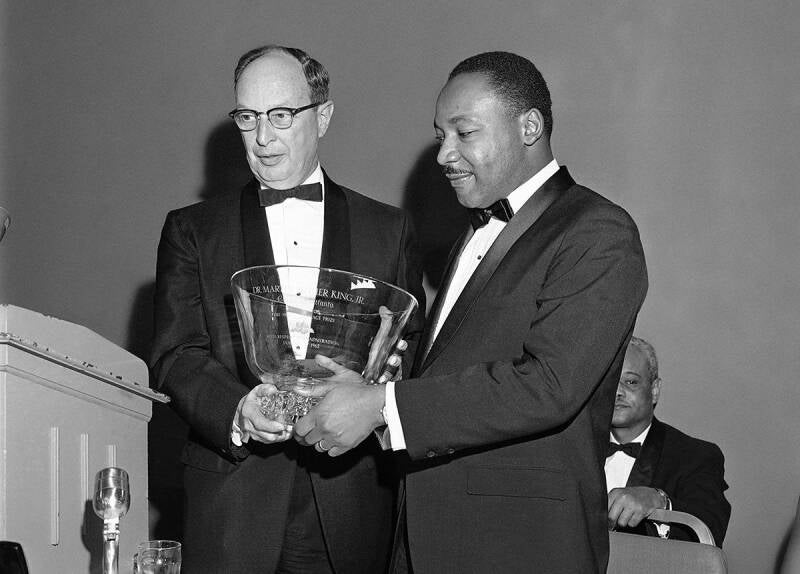
Rabbi Jacob M. Rothschild presenting a commemorative bowl to Martin Luther King, Jr. at a banquet at the Ansley Hotel in Atlanta, Georgia, to honor King as the recipient of the Nobel Peace Prize. Atlanta History Photograph Collection, Kenan Research Center at Atlanta History Center
It is also important to understand that this was not a righteous movement that was later hijacked after gaining influence. The framework, funding channels, political access, and media exposure were present from the earliest stages. King did not rise organically from uncontrolled grassroots revolt that later became negotiable. He was elevated rapidly, protected strategically, and placed into direct dialogue with national and international power structures from the start.
That does not happen to movements that threaten empire.
From early on, his platform was aligned with institutions, universities, churches tied to political donors, fraternal networks, and elite social organizations that already operated within established power structures. One of the clearest public examples of this alignment was his close relationship with Rabbi Jacob Rothschild of The Temple in Atlanta, a figure deeply connected to influential financial and political networks.
Rothschild was not a passive supporter standing on the sidelines.
He played an active role in organizing elite social backing, mobilizing affluent community resources, and hosting high-profile political and interfaith events that framed the movement within acceptable institutional boundaries. The banquet honoring King after his Nobel Peace Prize in 1964 was not merely a celebration, it was a public confirmation that the movement’s leadership had been fully integrated into elite approval channels.

This matters because genuine revolutionary movements are not welcomed into elite halls, funded by powerful benefactors, or celebrated by financial and political institutions whose wealth and influence were built on the very systems being protested. They are isolated, demonized, economically strangled, and violently suppressed.
But movements that can be shaped into integrationist reform projects, rather than structural dismantling campaigns, are supported, protected, and broadcast.
Partnerships with wealthy institutional figures did not emerge after the movement succeeded, they were part of how it was launched, stabilized, and guided. That reveals that the acceptable boundaries of leadership were already defined before the movement reached national visibility. In other words, the role itself was pre-approved, and the man was advanced into it.
This is how controlled opposition functions. Not by inventing leaders out of nothing, but by selecting individuals whose worldview, affiliations, and methods are compatible with long-term governance stability. The system does not need traitors, it needs manageable reformers who can redirect suffering into policy adjustments instead of systemic overthrow.
So, while many in the streets were risking their lives, losing jobs, being beaten, jailed, and murdered, the public face of the movement was being guided into speeches, legislation, televised negotiations, elite banquets, and symbolic victories that left economic power, land ownership, military authority, and financial systems completely untouched.
That is not accidental design. That is strategic containment.

This is why later attempts to pivot toward economic justice and war opposition were met with immediate hostility, surveillance, and silencing. Once a figure begins stepping outside the assigned boundaries, the usefulness ends. Controlled roles have limits, and those limits are enforced.
So, the dream was not merely reshaped after the fact.
It was deployed from the beginning as the acceptable emotional outlet for suffering that would never be allowed to become structural rebellion.
And the result is what we live with now, emotional symbolism without sovereignty, representation without restitution, visibility without power, and unity language that advances centralized control while communities remain economically trapped and culturally fragmented.
This is not accidental history.
It is patterned governance.
The Smokescreen of the Race War

Even the Black Panther movement, though fierce in its resistance and fiery in its defense, was still built upon the foundation of a manufactured identity. It fought to protect a concocted “Black culture” that had already been engineered by colonizers to replace the true covenant heritage of Yashar’al. The Panthers believed they were rising to restore dignity, but the very culture they defended was part of the deception foretold in the curses. And just as the Torah declared, their strength could not last. “You shall be only oppressed and crushed continually” (Deuteronomy 28:33) and “you shall become an astonishment, a proverb, and a byword, among all nations where 𐤉𐤄𐤅𐤄 (YaHU’aH) shall lead you” (Deuteronomy 28:37).
The movement was infiltrated, dismantled, and scattered—not merely because of government opposition, but because 𐤉𐤄𐤅𐤄 (YaHU’aH) had already spoken that without His covenant, no self-made liberation would stand. The Black Panthers rose as lions, but they defended a cage that was never theirs. Their dismantling was not the failure of courage, but the fulfillment of prophecy: every effort to build strength on a false identity will collapse until the true heritage is restored.

This complex web of control subtly conditions many to believe there is a “race war” to fight—a war over skin color, status, and pride—so that they will defend a culture that is not their true heritage. They are baited into conflict, rivalry, and division, while the real enemy—the one who orchestrated the hidden identity theft—remains unseen. This so-called race war is a smokescreen. It was never about Black vs White in the covenant sense. It was a tool to keep the true seed blinded, distracted, and fighting shadows. The colonizers invented the labels, scripted the narratives, fed lies about inferiority and superiority, and taught people to guard a cultural identity built on deception. In doing this, they kept the heritage of the true Hebrews hidden. Those who wage this war often do so thinking they defend “Black culture,” not realizing that culture was constructed by oppressors to replace what was lost. They fight over flags, symbols, and status, while the covenant truth—the language, the names, the commandments, the sacred identity—remains buried. Because of this great deception, many will never return to 𐤉𐤄𐤅𐤄 (YaHU’aH)’s covenant and will perish among the two-thirds spoken of: “And it shall come to pass, that in all the land, says 𐤉𐤄𐤅𐤄 (YaHU’aH), two parts therein shall be cut off and die; but the third shall be left therein. And I will bring the third part through the fire, and will refine them as silver is refined, and will test them as gold is tested... ‘It is My people,’ and they shall say, ‘𐤉𐤄𐤅𐤄 (YaHU’aH) is my AL’uah’” (ZakarYAHU (Zechariah) 13:8–9). Let the blinders fall: this is not a righteous war. The war they want you to fight is the one that keeps you from remembering who you are. The true heritage must be resurrected—not through defending false culture, but by reclaiming the covenant identity of Yashar’al. Only the remnant who awaken and return will be refined and preserved.

The Call to Covenant Truth
The reality of this prophetic judgment brings us back to the structural evidence. The hard truth that must be faced is this: these conditions themselves were curses. The people called Black are the only people on earth never taught their true history, never allowed to keep their native tongue, and never permitted to pass their covenant culture to the next generation. Every other nation, no matter how scattered, still holds language, customs, and memory. But the children of Yashar’al lost theirs under the curses of Deuteronomy 28: “And you shall serve your enemies which 𐤉𐤄𐤅𐤄 (YaHU’aH) shall send against you, in hunger, and in thirst, and in nakedness, and in want of all things... until he has destroyed you” (Deuteronomy 28:48). YarmiYAHU (Jeremiah) confirmed this loss: “And you, even yourself, shall discontinue from your heritage that I gave you” (YarmiYAHU 17:4). The stripping away of history and tongue is the clearest sign of who this people truly are.
Each of these elements—slavery identity labels, the destruction of the family unit, the welfare system, economic colonization, the slave trade scattering, the distinction that not all so‑called Black people are of the tribes, the presence of original dark‑skinned inhabitants in so‑called America, Jim Crow stereotypes, media inventions, education systems, holiday fabrications, consumer traps, political branding, the deception of the Black church, DEI, and the stripping away of history and tongue—prove that modern “Black culture” is not authentic heritage but a system of control. It was built layer upon layer to shape perception, define limits, and keep a people within the boundaries set by those who profited from their captivity. The truth of Yashar’al was covered under a mask, while the world was handed a fabricated identity to consume and repeat.
This entire chain of curses and deception leads to one unavoidable conclusion: the hour has come to leave the lies. 𐤉𐤄𐤅𐤄 (YaHU’aH) Himself warned that His people would be scattered into corners and their remembrance would cease from among men (Deuteronomy 32:26). He told Abram of a four-hundred-year affliction (Barashiyth (Genesis) 15:13–14). He foretold that two-thirds would be cut off and die but a third would be refined and preserved (ZakarYAHU (Zechariah) 13:8–9). We are living in the time when these words have already unfolded.
Everything you were taught to defend—your “race,” your “culture,” your “labels,” your “religion” shaped by colonizers—was part of the curses. It was not your inheritance but your prison. These things were designed to hide the covenant identity of Yashar’al and keep you in darkness. You cannot break free by fighting over them. You can only break free by turning back to 𐤉𐤄𐤅𐤄 (YaHU’aH) and His covenant.
Now is the moment to cast off the false names and false culture and to remember who you are. Return to the Torah, the commandments, and the consecrated identity that was given to your fathers. Call on the true Name of 𐤉𐤄𐤅𐤄 (YaHU’aH). Choose to be in the remnant—the one-third who are refined as silver and tested as gold—rather than perishing among the two-thirds who cling to deception.
This is not a call to hate, fight, or avenge. It is a call to wake yourself up to the truth all around you. The war of races is a smokescreen. The war for your identity is real. Leave the lies of the curses and embrace the covenant truth, because only those who return to 𐤉𐤄𐤅𐤄 (YaHU’aH) will stand when He gathers His people and judges the nations.
Jacob’s Trouble: This is What They Never Wanted You to Know
As more begin awakening to truths that were never hidden—only ignored—the machinery of deception grows louder and more aggressive than ever before. Even though what is seen can no longer be unseen, those who shape and control society’s narrative still manage to convince the simple-minded that blatant truth is a lie. Through this calculated manipulation, the wicked tirelessly work to cover, distort, and redefine the prophetic reality of Yaaqob’s trouble. Yet, despite this relentless effort to blind the people, there remains a remnant—a steadfast few who refuse to continue living with their eyes wide shut. They will not follow stories crafted only to stir emotion, distract the mind, and lead souls further from the prophetic clarity found in the Word. This study exists for them. Here, we will uncover the unbroken, uncontaminated His-story of Yaaqob’s trouble—a time unlike any other in existence. We will restore context to what the sacred Word has already declared, unveiling the truth about the great trouble of Yaaqob that the lawless have always labored to keep hidden—bringing Yaaqob’s trouble back into its rightful place—clear, unbroken, and undeniable.